
Nissan Safety Shield 360: How It Works in Oak Lawn
Driving in Oak Lawn requires a split-second reaction time, whether you are merging onto a congested I-294, navigating the busy intersections along 95th Street, or watching out for students near Oak Lawn Community High School. In the past, driver safety relied entirely on your ability to see a hazard and react manually. Today, modern vehicles act as an intelligent co-pilot, constantly monitoring the environment 360 degrees around you. Nissan has democratized this technology with Nissan Safety Shield® 360, a suite of six standard safety features available on nearly every new Nissan model, from the compact Versa to the rugged Frontier. Unlike other brands that hide essential safety tech behind expensive trim upgrades, Nissan believes safety should be standard. For local drivers, understanding exactly what these features do and what they don’t do is the key to maximizing protection for you and your family. This guide breaks down the technology, explains how to use advanced aids like ProPILOT Assist, and offers tips on maintaining the sensors that keep these systems running.
What Safety Shield 360 Includes
Nissan Safety Shield 360 is comprised of six specific technologies designed to prevent accidents from the front, sides, and rear. The first and perhaps most critical is Automatic Emergency Braking with Pedestrian Detection. This system uses forward-facing radar and cameras to monitor the distance between you and the car ahead. If traffic on Cicero Avenue comes to a sudden halt a common occurrence the system warns you to slow down. If you don’t react, it automatically applies the brakes to help avoid a collision or reduce the severity of the impact. Crucially, it also detects pedestrians crossing the street, a vital feature for driving in residential neighborhoods or busy shopping plaza parking lots. Complementing this is High Beam Assist, which automatically switches to low beams when it detects an oncoming vehicle, ensuring you don’t blind other drivers on dark stretches of Southwest Highway while maximizing your own visibility.
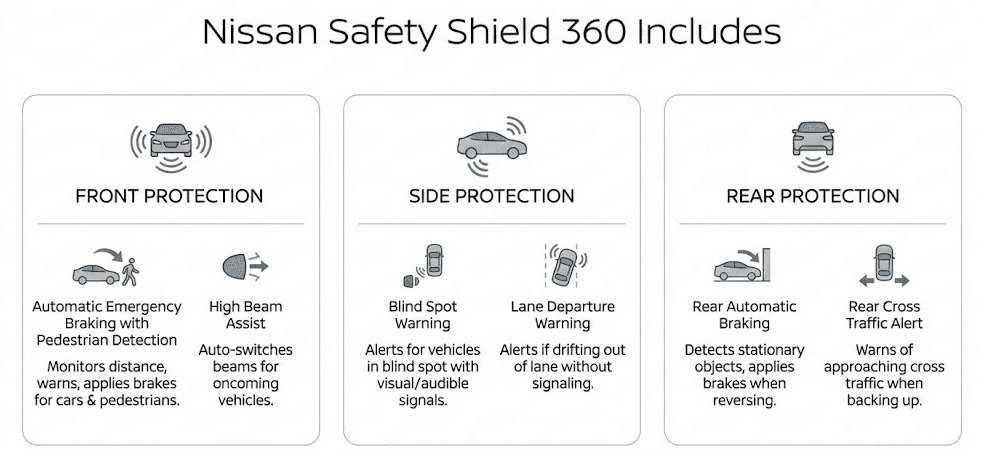
The second pair of features focuses on the sides of your vehicle. Blind Spot Warning is an essential tool for multi-lane driving. It keeps an eye on the blind spot area and illuminates a visual indicator on the A-pillar or side mirror if a vehicle is detected. If you activate your turn signal while a car is in that zone, an audible chime alerts you to stay in your lane. Working in tandem is Lane Departure Warning, which monitors lane markings. If you start to drift out of your lane without signaling perhaps due to distraction or fatigue the steering wheel will vibrate or a chime will sound to prompt you to correct your course. Finally, the rear of the vehicle is protected by Rear Automatic Braking and Rear Cross Traffic Alert. Rear Automatic Braking can detect large stationary objects (like a wall or a parked car) when backing up and apply the brakes if you fail to stop. Rear Cross Traffic Alert warns you if a car is approaching from either side while you are backing out of a parking space, saving you from those anxiety-inducing moments at the grocery store when you can’t see past the large SUV parked next to you.
Understanding the Alerts and Settings
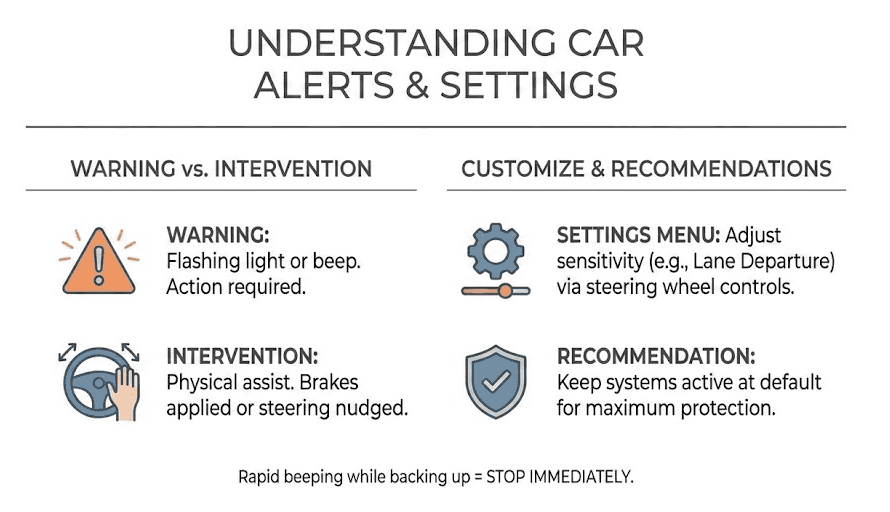
It is important for new owners to familiarize themselves with the language of their car. Not every beep means the same thing, and understanding the difference between a warning chime and an intervention is key. A “warning” usually consists of a flashing light or a beep, indicating that you should take action. An “intervention” is when the car physically assists you, such as applying the brakes or nudging the steering wheel. In the settings menu on your dashboard (accessible via the steering wheel controls), you can often customize the sensitivity of these alerts. For example, if you find the Lane Departure Warning to be too sensitive on narrow construction lanes, you can adjust it to “Standard” or “Reduced” sensitivity, or switch it to vibration only. However, we recommend keeping these systems active and at their default settings for maximum protection. Knowing that a rapid beeping sound while backing up means “stop immediately” can be the difference between a close call and a bumper repair.
ProPILOT Assist in Traffic and Parking
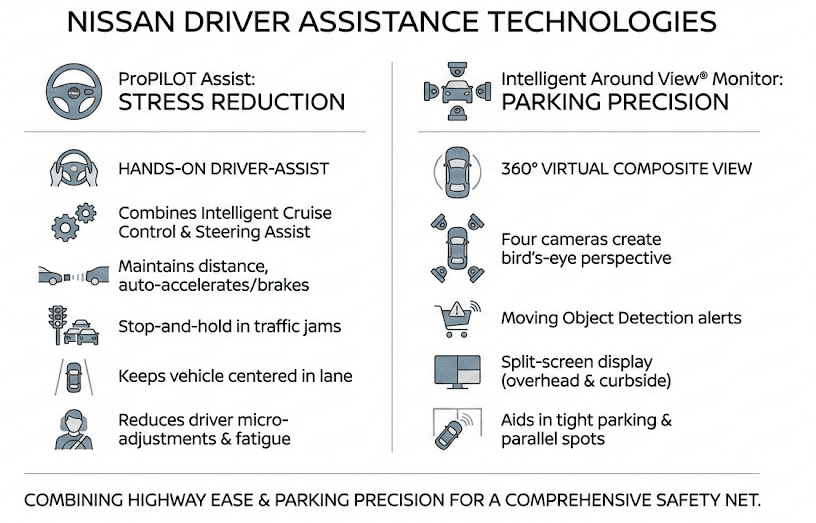
While Safety Shield 360 is about accident prevention, ProPILOT Assist is about stress reduction. Available on many Nissan models like the Rogue, Altima, and Pathfinder, ProPILOT Assist is a “hands-on” driver-assist system that combines Intelligent Cruise Control with Steering Assist. For Oak Lawn commuters fighting the daily gridlock on the Tri-State Tollway (I-294), this technology is a game-changer. Once activated with a simple blue button on the steering wheel, the system maintains a set distance from the car ahead, accelerating and braking automatically with the flow of traffic even bringing the car to a complete stop and holding it there during jams. At the same time, the Steering Assist uses cameras to read lane markers and provides gentle steering inputs to keep your vehicle centered in the lane. This reduces the micro-adjustments you constantly make as a driver, significantly lowering mental and physical fatigue during long drives.
Another technology that pairs perfectly with ProPILOT Assist is the Intelligent Around View® Monitor. While not part of the standard Safety Shield 360 bundle (it is usually on mid-to-high trims), it is indispensable for parking in Oak Lawn’s tighter lots. This system uses four cameras to create a virtual composite 360-degree bird’s-eye view of your vehicle. When pulling into a spot at the Metra station or parallel parking on a busy street, you can see exactly where your tires are relative to the painted lines and the curb. It also features Moving Object Detection, which alerts you if something moves into the camera’s view, such as a shopping cart or a pet. The split-screen display allows you to see the overhead view alongside a curbside view, ensuring you never scrape your alloy wheels again. By combining the highway ease of ProPILOT Assist with the parking precision of the Around View Monitor, Nissan provides a comprehensive safety net that covers every aspect of your journey.
Highway Driving vs City Streets
It is crucial to understand where to use these advanced features. ProPILOT Assist is designed specifically for highway use on roads with clear lane markings and gradual curves. It is not intended for city driving on streets like 95th Street where there are frequent intersections, traffic lights, and pedestrians. The system relies on seeing continuous lines; if the lines disappear in an intersection or are faded, the system may disengage. In the city, you should rely on the standard Safety Shield 360 features like Automatic Emergency Braking and Blind Spot Warning, which are always active in the background. On the highway, ProPILOT Assist shines, but drivers must remain alert. If the system detects that your hands have left the steering wheel for too long, it will issue a series of escalating warnings. If you still do not respond, it will eventually pulse the brakes and bring the vehicle to a controlled stop in its lane with the hazards on a safety measure designed to handle driver incapacitation.
Use Driver Assistance Responsibly
The rise of driver assistance technology has led to some misconceptions about “self-driving” cars. It is imperative for Oak Lawn drivers to understand that Nissan’s technologies are assists, not replacements for an attentive human driver. You are legally and physically responsible for the vehicle at all times. Systems like Automatic Emergency Braking are designed to intervene in critical situations, but they cannot defy physics. If you are driving too fast on icy roads, the system may brake, but the tires may not have enough traction to stop the car in time. Similarly, sensors have limitations. Heavy rain, thick fog, or snow buildup can blind the radar and cameras. When this happens, a warning message usually appears on the dashboard stating that the system is unavailable. In these conditions, you must drive with heightened caution, as you are operating without your digital safety net.
Keeping your sensors clean is a simple but vital part of vehicle maintenance that is often overlooked. The front radar sensor is typically located behind the Nissan emblem on the grille or in a square box in the lower bumper. In winter, this area can easily become caked with slush and road salt, disabling the Intelligent Cruise Control and Emergency Braking. A quick wipe with a damp cloth during your gas station stops can keep these systems online. Similarly, the windshield camera located behind the rearview mirror needs a clear view. If your windshield is covered in ice, scrape the entire glass, not just a porthole for yourself. The rear cameras and parking sensors also need to be kept clean of dirt and mud to function correctly. Treat these sensors like your own eyes; if they can’t see, they can’t help you.
Maintenance for Safety Systems
Beyond cleaning, the complex network of cameras and radars requires precise calibration to function correctly. If you are involved in a minor fender bender or even if you just have your windshield replaced due to a crack, the forward-facing camera must be recalibrated to ensure it is reading the road geometry accurately. If the camera is off by even a fraction of a degree, the Lane Departure Warning might alert you too late or too early, or the Emergency Braking might misjudge distances. At Kelly Nissan, our service center is equipped with the specialized targets and computer diagnostic tools required to perform this ADAS (Advanced Driver Assistance Systems) calibration. Whenever you schedule bodywork or glass replacement, always ask if the safety systems have been checked. Ignoring this step can lead to a vehicle that feels “glitchy” or unpredictable, compromising the very safety features you bought the car for.
Another important aspect of living with Safety Shield 360 is understanding how it interacts with insurance premiums. Many insurance providers in the Oak Lawn area offer discounts for vehicles equipped with active safety technology. Because features like Automatic Emergency Braking and Blind Spot Warning are proven to reduce the frequency and severity of accidents, insurers view these vehicles as lower risk. It is worth contacting your insurance agent to verify that they have your vehicle listed correctly with all its safety equipment. You might need to provide a copy of the window sticker or a letter from the dealership, which Kelly Nissan can happily provide. The savings on your premium can be substantial over the life of the car, effectively helping the technology pay for itself while it protects you.
Night driving presents its own set of challenges, particularly on poorly lit suburban streets where visibility is limited. This is where High Beam Assist proves its worth as an underrated hero of the Safety Shield 360 suite. By automatically toggling the high beams on and off based on surrounding traffic, it maximizes your field of vision without requiring constant manual input. This means you are more likely to spot a deer darting out from the forest preserves or a pedestrian walking on the shoulder. When combined with the Intelligent Driver Alertness system which monitors your steering patterns for signs of drowsiness your Nissan actively works to combat the two biggest dangers of night driving: poor visibility and fatigue. Trusting these systems allows you to focus more on the road ahead, making late-night drives home from Chicago safer for everyone sharing the road.
Finally, for parents of teen drivers in Oak Lawn, Nissan’s safety tech offers unparalleled peace of mind. Features like Lane Departure Warning act as a constant driving instructor, reinforcing the habit of using turn signals. The “NissanConnect® Services” app also allows parents to set customizable alerts, such as speed limits, curfew times, and boundary zones. If the vehicle exceeds a set speed or leaves a designated area (like Oak Lawn), you receive a notification on your smartphone. This doesn’t just protect the car; it encourages responsible driving habits in young drivers who are still learning the rules of the road. Knowing that the car will intervene if they get distracted provides a safety buffer during those critical first years of driving experience.
Visit Kelly Nissan to Learn More
Technology is only useful if you know how to use it, and at Kelly Nissan, we are dedicated to ensuring every customer feels like an expert in their own car. Whether you are a new owner confused by a dashboard light or a shopper comparing safety ratings, our team is here to demonstrate exactly how Nissan Safety Shield 360 works in the real world. We can help you adjust your settings, show you how to clean your sensors, and let you experience ProPILOT Assist on a test drive. Visit us on 95th Street today and drive away with the confidence that comes from having a 360-degree shield of protection.
0 comment(s) so far on Nissan Safety Shield 360: How It Works in Oak Lawn