
Nissan Tire Rotation and Alignment Guide in Oak Lawn
As spring approaches in Oak Lawn, the snow melts away to reveal the harsh reality of what winter has left behind: potholes, cracks, and uneven pavement on roads like 95th Street and Cicero Avenue. For Nissan owners, this seasonal transition is the critical time to address the components that connect your vehicle to the road: your tires. Neglecting tire health after a brutal Illinois winter is a recipe for premature wear, reduced fuel efficiency, and compromised safety. While the Nissan Rogue, Altima, and Sentra are engineered for reliability, their performance relies heavily on proper tire maintenance. Two of the most misunderstood yet vital services are tire rotation and wheel alignment. These are not just “upsells” at the service counter; they are fundamental maintenance procedures that extend the life of your investment and ensure your vehicle handles exactly as the engineers intended. This guide explores the mechanics behind these services, why they are crucial for local driving conditions, and how to spot the signs that your Nissan needs attention at Kelly Nissan.
Rotation Patterns by Drivetrain
Tire rotation is the practice of moving wheels and tires from one position on the vehicle to another to ensure even tread wear. It is a common misconception among Oak Lawn drivers that all four tires wear down at the same rate. In reality, the weight distribution of your vehicle, the drivetrain layout, and the forces of turning and braking cause tires to wear differently depending on their position. For a Front-Wheel Drive (FWD) vehicle like the Nissan Sentra or Kicks, the front tires bear the brunt of the work. They are responsible for steering, braking, and transferring power from the engine to the pavement. Consequently, the front tires on an FWD vehicle can wear out twice as fast as the rear tires if not rotated regularly. A proper rotation pattern for FWD vehicles typically involves moving the front tires straight to the back, while the rear tires are crossed to the opposite front positions. This “Forward Cross” pattern helps balance the wear, ensuring that each tire spends time on the “heavy” front corners and the “lighter” rear corners over its lifespan.
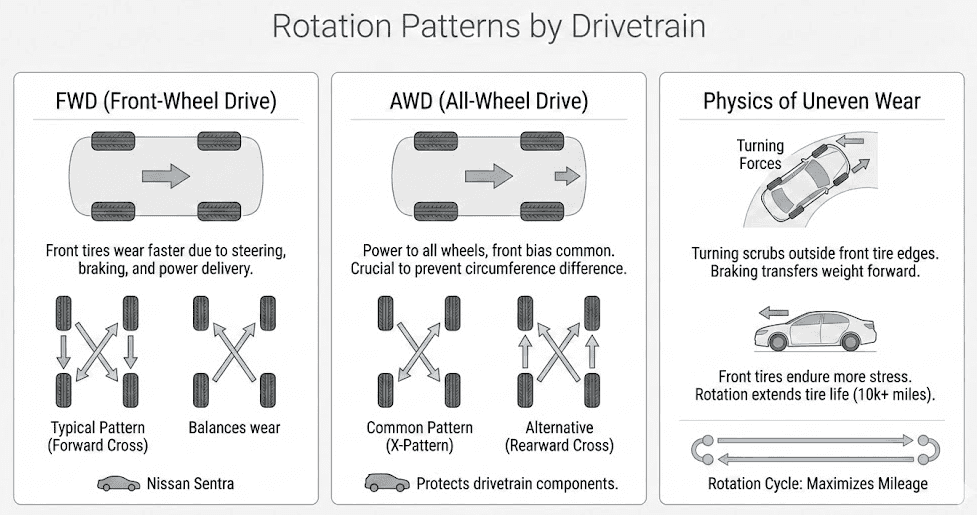
For All-Wheel Drive (AWD) vehicles like the Nissan Rogue or Pathfinder, the rotation pattern is equally important but slightly different. Even though AWD sends power to all four wheels, the system often biases power to the front for efficiency during normal driving in Oak Lawn. However, during winter acceleration or slippery conditions, the rear tires engage more frequently. The specific rotation pattern for AWD vehicles often involves an “X-pattern” where both front and rear tires cross to the opposite corners, or a “Rearward Cross” where the rear tires move forward straight, and the front tires cross to the back. Failing to rotate tires on an AWD vehicle can lead to a difference in tire circumference between the front and rear axles. Modern AWD systems, like Nissan’s Intelligent AWD, are highly sensitive; a significant difference in tire diameter caused by uneven wear can confuse the system, potentially causing damage to the center differential or transfer case. Therefore, sticking to the manufacturer’s recommended rotation pattern is not just about saving rubber; it is about protecting your vehicle’s sophisticated drivetrain components from costly mechanical failure.
The Physics of Uneven Wear
Understanding why tires wear unevenly helps emphasize the need for rotation. When you turn your steering wheel to navigate a tight corner in a parking garage or a roundabout, the outside edges of the front tires scrub against the pavement with significant force. Meanwhile, the rear tires simply follow the path of the front, experiencing much less lateral friction. Over thousands of miles of city driving in Oak Lawn, this results in “shoulder wear” on the front tires. Additionally, braking transfers the vehicle’s weight forward, compressing the front suspension and increasing the load on the front tires, which scrubs off more rubber. By rotating the tires, you move the rear tires which typically have flatter, more even wear to the front, giving the worn front tires a “vacation” on the rear axle where they endure less stress. This cycle maximizes the total mileage you can get from a set of tires, often extending their life by 10,000 miles or more compared to leaving them in static positions.
Alignment Symptoms and Road Hazards
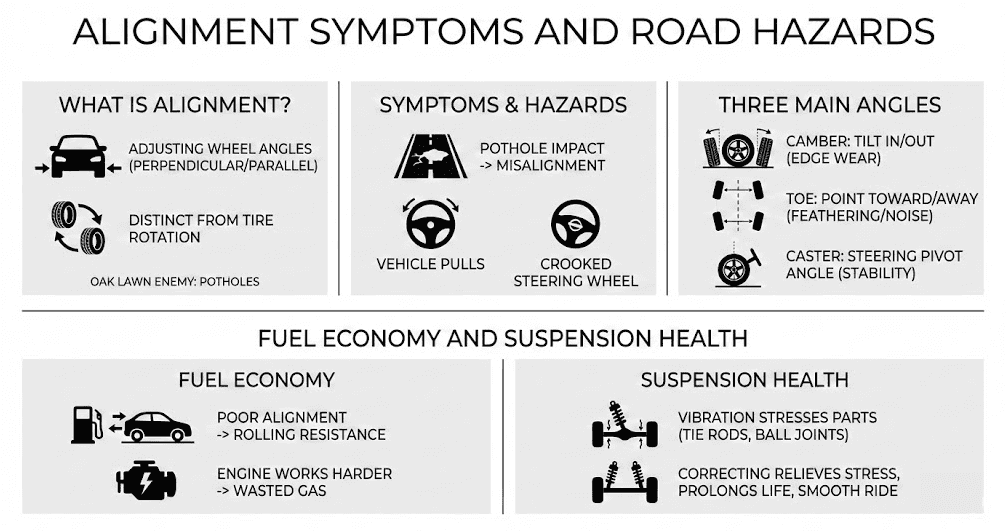
Wheel alignment is distinct from tire rotation, though the two are often performed together. While rotation involves moving the tires, alignment involves adjusting the angles of the wheels so they are perpendicular to the ground and parallel to each other. In Oak Lawn, the primary enemy of proper alignment is the pothole. Hitting a deep pothole on the Tri-State Tollway or a sunken manhole cover on a side street can jar the suspension components enough to knock the wheels out of spec. When a car is misaligned, the tires are essentially being dragged sideways as they roll forward. The most common symptom drivers notice is the vehicle pulling to one side. If you are driving straight on a level road and have to constantly apply pressure to the steering wheel to keep the car from drifting into the next lane, your alignment is likely off. Another sign is a steering wheel that is crooked when driving straight; the Nissan emblem should be perfectly level, not tilted to the left or right.
There are three main angles that technicians adjust during an alignment: camber, toe, and caster. “Camber” refers to the inward or outward tilt of the tire when viewed from the front. If you have negative camber, the top of the tires tilt inward; positive means they tilt outward. Too much tilt in either direction puts excessive load on one edge of the tire, leading to rapid, smooth wear on just one side of the tread. “Toe” is the most critical angle for tire life; it refers to the direction the tires point relative to the centerline of the vehicle, similar to looking down at your feet. “Toe-in” means the tires point toward each other, while “toe-out” means they point away. Incorrect toe settings cause “feathering,” where the tread blocks become sharp on one side and smooth on the other, creating a sawtooth pattern that causes loud road noise. Finally, “Caster” involves the angle of the steering pivot. While it affects straight-line stability and steering return more than tire wear, it is crucial for ensuring your Nissan feels stable at highway speeds.
Fuel Economy and Suspension Health
Beyond ruining tires, poor alignment has a parasitic effect on your fuel economy. Imagine trying to push a shopping cart with a wobbly wheel that wants to go left while you push straight; it requires significantly more physical effort. The same principle applies to your car. When wheels are misaligned, they create rolling resistance because they are fighting against the direction of travel. This resistance forces the engine to work harder to maintain speed, burning more fuel in the process. For an Oak Lawn commuter driving 15,000 miles a year, a bad alignment could cost hundreds of dollars in wasted gas. Furthermore, the vibration caused by misalignment stresses other suspension parts. Tie rod ends, ball joints, and control arm bushings take a beating when they are constantly under the tension of a misaligned wheel. Correcting the alignment relieves this stress, ensuring that your suspension components last longer and your ride remains smooth and comfortable, protecting your wallet from multiple angles.
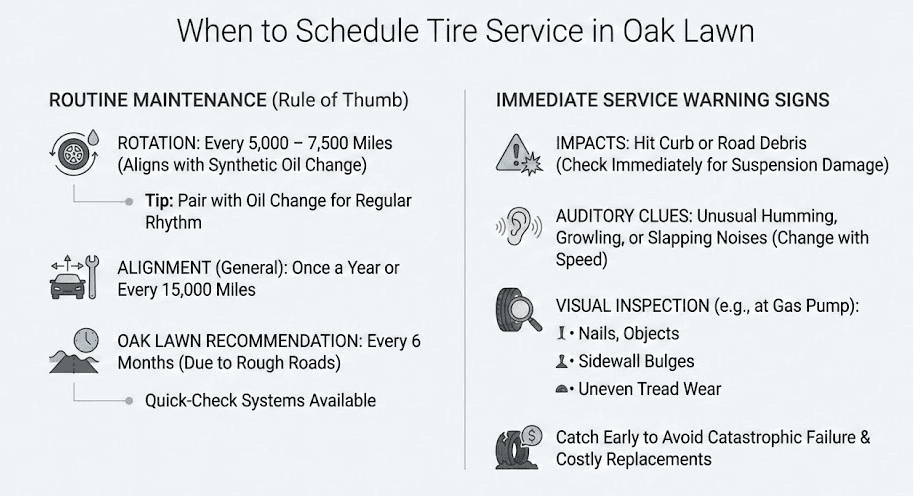
When to Schedule Tire Service in Oak Lawn
Knowing when to schedule these services can save you from the headache of a blowout or a failed inspection. As a general rule of thumb, Nissan recommends rotating your tires every 5,000 to 7,500 miles. Conveniently, this interval aligns perfectly with the recommended oil change schedule for most modern Nissan vehicles using synthetic oil. By pairing your tire rotation with your oil change at Kelly Nissan, you ensure it is never forgotten. It creates a regular maintenance rhythm that keeps your car in peak condition. For alignment, the recommendation is typically once a year or every 15,000 miles. However, in Oak Lawn, where road conditions can be rougher, we often suggest having the alignment checked every six months. Most dealerships, including ours, have quick-check systems on the service drive that can verify if your alignment is within spec in just a few minutes without even putting the car on a lift.
Immediate service is required if you notice specific warning signs. If you hit a curb while parking or strike a large piece of road debris, do not wait for the scheduled interval; bring the vehicle in for a check immediately. Suspension damage can be subtle at first but can lead to catastrophic tire failure if the alignment is severely out of spec. Additionally, listen to your tires. Unusual humming, growling, or slapping noises that change pitch with vehicle speed are often the first auditory clues of irregular wear patterns caused by lack of rotation or alignment issues. Visually inspecting your tires while you fill up gas is also a good habit. Look for nails, bulges in the sidewall, or tread that looks significantly lower on one side of the tire than the other. Catching these issues early allows for correction before the tire is ruined, potentially saving you the cost of replacing a tire that still has plenty of life left in it.
DIY Tread Depth Inspection
While professional equipment is best for alignment, you can easily monitor your tire wear at home in your driveway. The most important metric is tread depth, which determines your ability to stop in rain and snow. New tires typically start with 10/32 to 11/32 of an inch of tread. In Illinois, tires are considered legally worn out at 2/32 of an inch, but for safe winter driving in Oak Lawn, we recommend replacing them when they reach 4/32 or 5/32. You can use the “Penny Test” to check this. Insert a Lincoln penny into the tread groove with Lincoln’s head facing down. If you can see all of Lincoln’s head, your tread is too shallow (less than 2/32″) and the tire is unsafe. If part of his head is covered, you have some life left. Most modern tires also have “wear bars” small rubber bridges between the tread blocks. When the tread wears down to be flush with these bars, it is time for new tires. Regularly checking these indicators gives you a clear timeline for when you will need to budget for replacements.
Temperature fluctuations play a significant role in tire maintenance that many drivers overlook, especially during the transitional months of spring and fall. For every 10-degree drop in ambient temperature, your tire pressure can decrease by about 1 PSI. In Oak Lawn, where temperatures can swing from 60°F during the day to 30°F at night in March, this can trigger your Tire Pressure Monitoring System (TPMS) light in the morning. Driving on under-inflated tires increases friction and heat buildup, which can lead to tire failure, while over-inflated tires reduce traction and cause the center of the tread to wear out prematurely. We recommend checking your tire pressure monthly with a handheld gauge when the tires are “cold” (meaning the car hasn’t been driven for a few hours) to get an accurate reading.
The quality of the tire you choose to put on your vehicle also dictates how frequently it might need attention and how long it lasts. At Kelly Nissan, we always recommend replacing tires with Original Equipment Manufacturer (OEM) or equivalent top-tier brands like Michelin, Bridgestone, or Goodyear. These tires are designed with the specific weight and handling characteristics of your Nissan in mind. Cheaper, “budget” tires often use harder rubber compounds that might last longer but provide significantly less grip in wet weather, or softer compounds that grip well but wear out in less than 20,000 miles. Investing in high-quality tires often comes with better treadwear warranties, meaning if they wear out prematurely despite you doing regular rotations and alignments, the manufacturer may pro-rate the cost of the next set, saving you money in the long run.
Finally, consider the benefit of Road Hazard Coverage when you purchase new tires. The roads in and around Oak Lawn are notorious for debris nails from construction sites, glass, and sharp rocks are common hazards. A standard tire manufacturer warranty typically covers defects in materials and workmanship, but it does not cover a flat tire caused by running over a nail on 95th Street. Road Hazard Coverage, which is often available through the Kelly Nissan Tire Center, acts like an insurance policy for your tires. If you get a puncture that cannot be safely repaired, or if a pothole creates a bubble in the sidewall, this coverage can pay to repair or replace the tire entirely. Given the cost of modern tires, which can run upwards of $200 each for larger SUVs, having this protection provides immense peace of mind for local drivers.
Book Your Spring Tire Service at Kelly Nissan
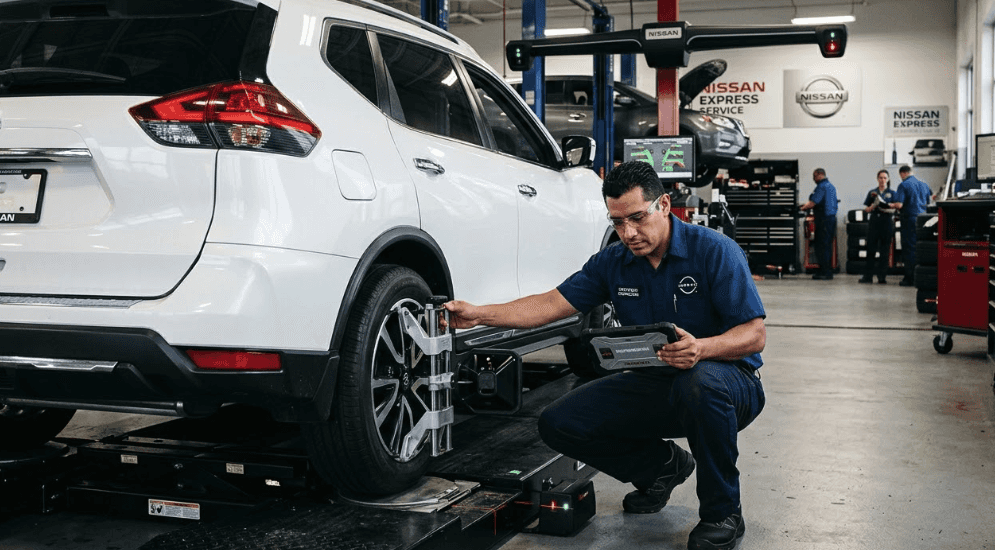
Don’t let the remnants of winter ruin your tires and your ride quality. At Kelly Nissan in Oak Lawn, our factory-trained technicians are experts in Nissan suspension and tire care. We use precision laser alignment technology to ensure your wheels are set to the exact factory specifications of your Rogue, Altima, or Pathfinder. Whether you need a simple rotation, a pothole-recovery alignment, or a brand-new set of tires, we are here to help you drive safely. Schedule your appointment today and feel the difference of a perfectly aligned vehicle.
0 comment(s) so far on Nissan Tire Rotation and Alignment Guide in Oak Lawn